Wednesday, August 31, 2022

Top 40 countdown: John Friesz, Jason Gesser and Ryan Leaf set the standard for greatness among local college QBs over the past 40 seasons


Top 40 countdown: John Friesz, Jason Gesser and Ryan Leaf set the standard for greatness among local college QBs over the past 40 seasons


By John Blanchette Spokane Spokesman-Review 8/31/2022


In the quest to rank every sporting thing under the sun comes this contribution in which apples will be compared to … apple cider vinegar.

Actually, it’s quarterbacks to quarterbacks, but you’ll get the drift.

With apologies to Billy Diedrick and Slingin’ Steve Olson and the Throwin’ Samoan – standard setters of the 1960s and 70s – it’s pretty much a given that the Golden Age of College Quarterbacking in our neck of the gridiron extends from the early 1980s to today. In that span, the college programs of the Inland Northwest have produced 10 NFL draft picks, five Walter Payton Award winners and 26 of the 30 winningest quarterbacks in the schools’ collective histories.

So 40 pretty good years. Let’s see if we can come up with the best quarterbacks, from 1 to 40.

There is a built-in flaw in the construct of this endeavor, of course. Our neighborhood schools range from a Power 5 program to an FCS redblood to a football-in-proper-perspective retreat that offers no athletic scholarships – plus Idaho, which has pinballed from one perch to another. How can you compare an Idaho quarterback against Washington State’s best? How can the Whitworth guy possibly be measured against his Eastern Washington placeholder?

Only from a virtual barstool like this.

For ingredients, we began with every quarterback who started a game in the past 40 seasons – yes, Kevin Lopina is in there, and Ed Powers and Andy Beitia, too. Then we cooked up a database stew of stats, honors won, rivalries dominated, championships, bowls and playoffs achieved and, perhaps most important, pitcher-of-record determinations.

Then we salted it to our taste.

That means three-year starters had the advantage over one-year wonders, unless that single season was a watershed moment. That means, given the programs’ relative statues, a 12-win Wazzu quarterback might have more heft than an Eastern guy with 22 to his name, especially since the EWU guy couldn’t get off the bench when he became a Cougar.

Still, you’ll note that there are three Division III quarterbacks in there among the guys who celebrated FCS playoff and Apple Cup victories – and no, even though all three were conference players of the year, it’s improbable that any would have taken a snap in the Pac-12.

But if that’s all this exercise is about, then you might as well rank Cougar quarterbacks 1-through-15, then tack on the 10 best from Eastern and Idaho and call it a day with a top 25.

Ultimately, after all the honors and statistical ratings, the tipping point needs to be value – how much these quarterbacks meant in reaching peaks and pulling programs out of valleys. Who was calling the signals in the defining moments? Who lifted a team to unexpected heights?

So you get, say, WSU’s Gardner Minshew at No. 5 despite being a one-off transfer, as he passed the Cougars to their first 11-win season in history.

You get John Welsh, who as a freshman led Idaho to its first bowl game – and victory – over Connor Halliday, the only Coug to throw for more than 700 yards in a game.

You get Bo Levi Mitchell and his national championship ahead of fellow Eastern greats Matt Nichols and Erik Meyer, who won 47 games between them.

And you get Idaho’s John Friesz at No. 1 over WSU’s two Rose Bowl quarterbacks.

Here’s the raw resume: First quarterback in the area to throw for more than 4,000 yards in a season. First to win the Payton Award as the top FCS offensive player. Three time Big Sky player of the year. Twenty-nine wins – and a 22-2 conference record. And three Big Sky championships.

One more bit of bookkeeping: Only performances from 1982 on have been factored. That robs Idaho’s Kenny Hobart of two productive seasons and maybe a spot higher on the ladder. And it also bumped WSU’s Clete Casper from the fab 40 completely, with the Cougars’ 1981 Holiday Bowl season eliminated – though he remains the quarterback of record in the most stunning Apple Cup upset in history.

So start your quibbles. It’s all about armchair quarterbacking now. Maybe next time we’ll fashion a top 40 for that.

1. John Friesz, Idaho, 1986-89

2. Jason Gesser, WSU, 1999-02

3. Ryan Leaf, WSU, 1995-97

4. Vernon Adams, EWU, 2012-14

5. Gardner Minshew, WSU, 2018

6. Eric Barriere, EWU, 2017-21

7. Drew Bledsoe, WSU, 1990-92

8. Doug Nussmeier, Idaho, 1990-93

9. Luke Falk, WSU, 2014-17

10. Bo Levi Mitchell, EWU, 2010-11

11. Timm Rosenbach, WSU, 1986-88

12. Mark Rypien, WSU, 1982-85

13. Erik Meyer, EWU, 2002-05

14. Ken Hobart, Idaho, 1982-83

15. Alex Brink, WSU, 2004-07

16. Matt Nichols, EWU, 2006-09

17. Anthony Gordon, WSU, 2018-19

18. Matt Kegel, WSU, 2000-03

19. Gage Gubrud, EWU, 2015-18

20. John Welsh, Idaho, 1998-01

21. Connor Halliday, WSU, 2011-14

22. Scott Linehan, Idaho, 1982-86

23. Nathan Enderle, Idaho, 2007-10

24. Joel Clark, Whitworth, 2003-06

25. Rick Worman, EWU, 1984-85

26. Harry Leons, EWU, 1994-97

27. Matt Linehan, Idaho, 2014-17

28. Josh Blankenship, EWU, 2002

29. Rick Sloan, Idaho, 1984-85

30. Jayden de Laura, WSU, 2020-21

31. Ian Kolste, Whitworth, 2013-17

32. Ryan Fien, Idaho, 1996

33. Eric Hisaw, Idaho, 1992-95

34. Ricky Turner, WSU, 1982-3

35. Brian Brennan, Idaho, 1994-97

36. Fred Salanoa, EWU, 1999-01

37. Mark Tenneson, EWU, 1989-92

38. Brian Lindgren, Idaho, 2001-03

39. Chad Davis, WSU, 1994-95

40. Scott Biglin, Whitworth, 1999-02

Monday, August 15, 2022

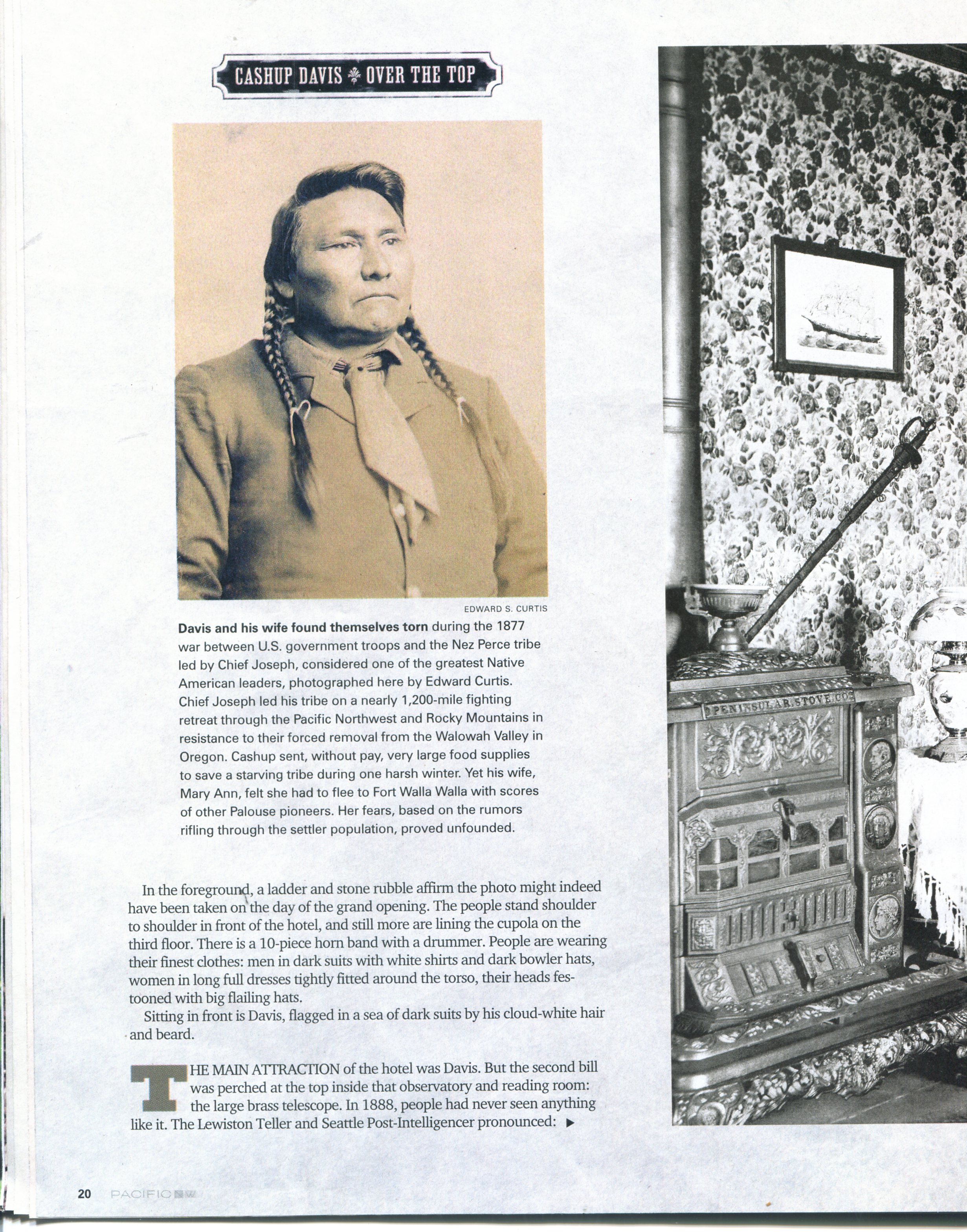
CASHUP DAVIS elevated the Palouse experience in the 1880s (Pacific NW magazine of Seattle Times Aug. 7, 2022)


Obituary: Richard “Rick” Wayenberg (July 27, 2022)


Obituary: Richard “Rick” Wayenberg

Richard (Rick) Allen Wayenberg, of Pullman, died Wednesday, July 27, 2022, following surgery at Providence Sacred Heart Medical Center in Spokane, Wash., for an aortic aneurysm. He was 71.

Rick was born May 21, 1951, in Yakima, Wash., to Warren J. “Bub” and M. Janice Wayenberg. He was raised on a 100-acre fruit ranch in the Moxee Holland district.

He attended Terrace Heights Elementary School (Yakima) and graduated from East Valley High School (Yakima) in 1969. He attended Yakima Valley College before studying at Washington State University and graduating in 1973 with a degree in Communications. He interned at the Camas (Wash.) Post-Record as a reporter/photographer.

Rick was a sports editor for the Bozeman (Mont.) Daily Chronicle, then a reporter for the Ketchikan (Alaska) Daily News before returning to Pullman as a sports editor for the Pullman Herald from 1974-76 and again 1980-81. Rick was a student teacher and wrestling coach for Clarkston (Wash.) High School and earned his teaching certificate in 1978 from WSU. Later he was an English teacher and wrestling coach for Columbia High School, Richland, Wash.  

He taught and coached wrestling at Sutherlin (Ore.) High School and later spent two years (1981-83) with the U.S. Sports Academy in Riyadh, Saudi Arabia, and Manama, Bahrain, as Public Relations Director promoting sports programs.  

In 1984 he earned a M.S. degree in physical education with emphasis in administration and public relations from WSU. As part of the degree requirement Rick provided public relations support for the WSU Department of Physical Education. He also served as an WSU assistant wrestling coach. During his early years in Pullman he also helped manage the photo/camera area of the White Drug Store.

A popular coach and wrestling official, Rick coached club and Pullman High School wrestling.  

In 1984 he moved to Emmett, Idaho, where he taught junior high school language arts and coached junior high and high school wrestling. Rick coached freestyle Greco Roman club teams for 23 years and served as an official at regional, national and Olympic Trials events for 30 years

He retired in 2006 and moved to Pullman to be closer to family and the Cougar Nation. Rick went to work for the Students Book Corporation (Bookie) in textbooks and became the Bookie Too, manager until the store closed.

He was inducted into the Idaho Chapter of the National Wrestling Hall of Fame in 2008 for a lifetime of service to wrestling…and most importantly to young people.

In Pullman he reconnected with friends and began volunteering at Pullman Regional Hospital, his favorite being at the Information Desk. He also enjoyed being on the chili crew for the National Lentil Festival and the cotton candy gang for the Chamber’s Fourth of July celebration at Sunnyside Park. Rick was always available to help photograph the Junior Miss /Distinguished Young Women Scholarship Program for media and help with Gladish Community and Cultural Center activities. He seldom missed an estate sale in the area.

He officiated track and field meets for Pullman Comets, PHS, WSU, University of Idaho, Eastern in Washington University, USA Track and Field and Junior Olympic meets in the region and WIAA/Washington Interscholastic Activities Association High School state championship A/ B1/ B2 meets at EWU.

Rick is survived by his son, Mike (Jenny) Stoneberg, grandson Kaiden and granddaughter Kira all of Meridian, Idaho; his sister, Sue (Mike) Hinz of Pullman; nephews John (Salustra) Hinz of Pullman, and Bill (Heather) Hinz of Eugene, Ore.; great-nephews Archer of Spokane and Coen of Eugene; great-niece Eisley of Eugene; Uncles Jerry, Jim, and Bob Talley, and one aunt, Dorothy Russell, all of the Shreveport, La., area; one aunt, Sandra Sasser, of Livingston, Texas; and many cousins and their growing families.

His parents and two uncles preceded him in death.

The family recognizes the efforts of Rick’s neighbors Freddy and Elsa Camacho, Pullman EMTs, Pullman Regional Hospital Emergency Room staff, Life Flight crew members and Sacred Heart surgeons on July 13 for extraordinary effort to get Rick the care he needed.

A celebration of Rick’s life is set for Saturday, Aug. 13, from 3-6 p.m. at the View Room of Gladish Community and Cultural Center.

The family suggests that support in Rick’s memory be made to local club or school wrestling programs, patient services at Pullman Regional Hospital through its Foundation or other community activities.

From: Sue <suehinz@gmail.com>
Date: August 2, 2022 at 10:49:01 PM PDT


Saturday, August 6, 2022

Death of WSU grad and Cougar fan RICK WAYENBERG 7/27/2022


Obituary: Richard “Rick” Wayenberg

Richard (Rick) Allen Wayenberg, of Pullman, died Wednesday, July 27, 2022, following surgery at Providence Sacred Heart Medical Center in Spokane, Wash., for an aortic aneurysm. He was 71.

Rick was born May 21, 1951, in Yakima, Wash., to Warren J. “Bub” and M. Janice Wayenberg. He was raised on a 100-acre fruit ranch in the Moxee Holland district.

He attended Terrace Heights Elementary School (Yakima) and graduated from East Valley High School (Yakima) in 1969. He attended Yakima Valley College before studying at Washington State University and graduating in 1973 with a degree in Communications. He interned at the Camas (Wash.) Post-Record as a reporter/photographer.

Rick was a sports editor for the Bozeman (Mont.) Daily Chronicle, then a reporter for the Ketchikan (Alaska) Daily News before returning to Pullman as a sports editor for the Pullman Herald from 1974-76 and again 1980-81. Rick was a student teacher and wrestling coach for Clarkston (Wash.) High School and earned his teaching certificate in 1978 from WSU. Later he was an English teacher and wrestling coach for Columbia High School, Richland, Wash.

He taught and coached wrestling at Sutherlin (Ore.) High School and later spent two years (1981-83) with the U.S. Sports Academy in Riyadh, Saudi Arabia, and Manama, Bahrain, as Public Relations Director promoting sports programs.

In 1984 he earned a M.S. degree in physical education with emphasis in administration and public relations from WSU. As part of the degree requirement Rick provided public relations support for the WSU Department of Physical Education. He also served as an WSU assistant wrestling coach. During his early years in Pullman he also helped manage the photo/camera area of the White Drug Store.

A popular coach and wrestling official, Rick coached club and Pullman High School wrestling.

In 1984 he moved to Emmett, Idaho, where he taught junior high school language arts and coached junior high and high school wrestling. Rick coached freestyle Greco Roman club teams for 23 years and served as an official at regional, national and Olympic Trials events for 30 years 

He retired in 2006 and moved to Pullman to be closer to family and the Cougar Nation. Rick went to work for the Students Book Corporation (Bookie) in textbooks and became the Bookie Too, manager until the store closed.

He was inducted into the Idaho Chapter of the National Wrestling Hall of Fame in 2008 for a lifetime of service to wrestling…and most importantly to young people.

In Pullman he reconnected with friends and began volunteering at Pullman Regional Hospital, his favorite being at the Information Desk. He also enjoyed being on the chili crew for the National Lentil Festival and the cotton candy gang for the Chamber’s Fourth of July celebration at Sunnyside Park. Rick was always available to help photograph the Junior Miss /Distinguished Young Women Scholarship Program for media and help with Gladish Community and Cultural Center activities. He seldom missed an estate sale in the area.

He officiated track and field meets for Pullman Comets, PHS, WSU, University of Idaho, Eastern in Washington University, USA Track and Field and Junior Olympic meets in the region and WIAA/Washington Interscholastic Activities Association High School state championship A/ B1/ B2 meets at EWU.

Rick is survived by his son, Mike (Jenny) Stoneberg, grandson Kaiden and granddaughter Kira all of Meridian, Idaho; his sister, Sue (Mike) Hinz of Pullman; nephews John (Salustra) Hinz of Pullman, and Bill (Heather) Hinz of Eugene, Ore.; great-nephews Archer of Spokane and Coen of Eugene; great-niece Eisley of Eugene; Uncles Jerry, Jim, and Bob Talley, and one aunt, Dorothy Russell, all of the Shreveport, La., area; one aunt, Sandra Sasser, of Livingston, Texas; and many cousins and their growing families.

His parents and two uncles preceded him in death.

The family recognizes the efforts of Rick’s neighbors Freddy and Elsa Camacho, Pullman EMTs, Pullman Regional Hospital Emergency Room staff, Life Flight crew members and Sacred Heart surgeons on July 13 for extraordinary effort to get Rick the care he needed. 

A celebration of Rick’s life is set for Saturday, Aug. 13, from 3-6 p.m.at the View Room of Gladish Community and Cultural Center.

The family suggests that support in Rick’s memory be made to local club or school wrestling programs, patient services at Pullman Regional Hospital through its Foundation or other community activities.

###


Monday, August 1, 2022

WSU’s Aron Baynes recovers from injury to resume basketball career in Australia


 WSU’s Aron Baynes recovers from injury to resume basketball career in Australia

One year after suffering a devastating injury, Aron Baynes has recovered and returned home to resume his basketball career.

 By Colton Clark Spokesman-Review of Spokane/Inland Empire 7/29/2022

 Baynes, a pro hoops veteran from Australia and a 2009 Washington State graduate, signed last week with the Brisbane Bullets of the NBL.

“I’m excited every day – excited to be out there, running around,” Baynes said Thursday during an introductory news conference in Brisbane. “Over the last few years, with the COVID stoppages and myself going through an injury, I know my happy place is being on the basketball court.”

Baynes sustained a career-threatening spinal cord injury while playing for Team Australia at last year’s Olympics in Tokyo. He fell during warmups before a game against Nigeria. Three days later, in the middle of a game against Italy, he took a hard fall in the locker room and was later found unconscious, according to ESPN.

Thus began a grueling rehabilitation process. Baynes couldn’t walk for two months, per ESPN, but soldiered on and eventually made a remarkable bounce-back, returning to the court earlier this year for limited basketball activities. A three-time Olympian and longtime NBA journeyman, Baynes reportedly worked out for a handful of NBA teams this summer before agreeing to a two-year deal with Brisbane – the capital city of Baynes’ home state of Queensland.

“I’m trying to build the program here and I’m looking forward to what we can do for basketball here in Queensland,” he said. “It’s the state I grew up in. Basketball’s been great to me. Trying to give back on and off the court is a big part of why I wanted to be here.

“My family’s in Brisbane. So, trying to build the community that my family is a part of is definitely something that’s big for me.”

His contract includes an international player buyout clause, which allows Baynes to return to the NBA should he receive an offer.

He played in the NBA for nine consecutive seasons before his injury, beginning his career in San Antonio in 2012. He held down a role for the Spurs for three seasons – helping the team to an NBA title in 2014 – before short stints with Detroit, Boston, Phoenix and Toronto. Baynes has appeared in 522 NBA games and his career averages stand at 6 points (on 49% shooting), 4.6 rebounds and 0.5 blocks per game.

“My ultimate goal is to get back to the NBA,” he said Friday on a Brisbane radio show. “It’s kinda one of those things that (NBA teams) need me to show them what I can do and still do it at the same level. I need to go out there and compete and play five-on-five. The opportunity to do it at home around my kids and to be with my family during the nights, and to go pick them up from school, that was pretty much the icing on the cake. You can’t ask for a much better situation than that. I’m happy we were able to work something out with the Bullets.”

Brisbane general manager Sam Mackinnon, quoted in a news release, called Baynes a “game-changer in the NBL.” It wasn’t long ago that Baynes was a key contributor in the NBA. In fact, he’s less than three years removed from his finest NBA performance – he poured in 37 points and drained nine 3-pointers for the Suns in one 2020 outing. Baynes and former NBA MVP James Harden are the only players in league history to record 35-plus points, 15-plus rebounds and nine or more 3s in one game.

“I’m just going out and doing what I’m known to do, how I play basketball – that’s what got me into the NBA to begin with,” Baynes said Thursday. “It’s about going out there and playing the right way every time I hit the floor and showing that I still can do what I was able to do before.”

Baynes went unselected in the 2009 NBA draft and spent a few seasons as an international pro after a distinguished career at WSU. The 6-foot-10 center tallied more than 1,000 points across four seasons from 2005-09, starting 86 college games and finishing his WSU career with per-game averages of 8.7 points (on 54.6% shooting), 5.4 rebounds and 0.8 blocks. The Cougs made back-to-back NCAA Tournament appearances in his final two seasons.

Baynes will make his official comeback to pro competition when Brisbane opens its season Oct. 1.

https://www.spokesman.com/stories/2022/jul/31/washington-states-aron-baynes-recovers-from-injury/

Retired WSU administrator Mary Jo Gonzales lights viral spark with story of student loan forgiveness


Retired WSU administrator Mary Jo Gonzales lights viral spark with story of student loan forgiveness

By Shawn Vestal, Spokane S-R 7/31/2022

Mary Jo Gonzales borrowed about $90,000 to earn the graduate degrees that would allow her to pursue a career in higher education.

A year or so after she received her doctorate from Washington State University, in 2002, she consolidated those various loans and a decade’s worth of accumulated interest into one large lump sum – about $133,000 to be repaid over 33 years.

This year, after her retirement from a distinguished career serving first-generation and low-income students in higher education and after making payments for more than two decades, her remaining principal was $94,000.

“During those 20 years,” she wrote in a recent social media post, “I repaid more than two times the original loan balance.”

Gonzales, who retired for medical reasons as vice president of student affairs at Washington State University last November, recently was approved for the Biden administration’s expanded student loan forgiveness program.

She posted about it on LinkedIn, and her words went viral – the story of a university vice president whose student debt outlasted her career reached more than 10,000 people, she said last week. She’s heard from people all over the country who are carrying massive debt while making little progress on the hamster wheel of interest payments.

Gonzales knew she was taking on a long-term responsibility when she borrowed to get an education. She hadn’t realized at the front end, though, how high interest and lower income-based payments would combine to make it so she literally did not put a dent in the principal year after year.

“I knew I was mortgaging my future,” Gonzales said. “What I didn’t know was how that interest would escalate my loan payment. … I really thought I could pay it off sooner.”

Gonzales made a very good salary since 2017 at WSU – more than $270,000 in her final year. She understands that many people might look askance at her receiving loan forgiveness.

But her circumstances were complicated when she came down last year with sepsis, a serious blood infection from which she’s still recovering. And the loan forgiveness program is not intended as hardship relief, but a way of encouraging people to go into fields like education or nonprofit work and rewarding those who are diligent about repayment over at least a decade.

The repayment amount for her consolidated loan was based on earlier, much lower incomes, she said. During the past few years at WSU, she continued making those automatic payments while trying to eliminate other debts and pay for her daughter’s undergraduate education at WSU, she said.

At age 53, she planned to keep working and paying off the loan. But when she was forced to retire, her income vanished and future job prospects became uncertain.

“I didn’t make the decision to apply for federal loan forgiveness until I couldn’t work in my position anymore,” she said. “I was mortified that I couldn’t continue to pay it the way I had intended to.”

‘This backpack’

Her debt was erased under a temporary expansion of the Public Service Loan Forgiveness program, which forgives student loan debts for people in public-service jobs who have made payments for at least a decade, while meeting other conditions.

The program was temporarily expanded last year to allow people to seek waivers for exceptions – such as a missed payment or the forgiveness of a type of loan previously not included.

Before 2021, more than 460,000 people had their debt forgiven, which represents less than 3% of all applicants, according to the Education Data Initiative. In 2021, another 30,000 borrowers had their debts forgiven under the temporary expansion, with an average debt of more than $66,000.

Less than 7% of eligible borrowers apply. One reason Gonzales shared her experiences publicly was to let more people know they may qualify, she said. The expanded PSLF guidelines are set to expire later this year.

Gonzales received her approval on June 5, letting her know that her student loan balance had been reduced from more than $94,000 to zero.

“There had always been this backpack on my back,” Gonzales said. “It was amazing to be able to put it down after 20 years.”

Gonzales’ experience says a lot about the way our system of higher ed works – and doesn’t work – for young people without means or a family tradition of attending college.

After decades of declining state support for colleges, and a steep erosion of nonloan aid such as the federal Pell Grant, the educational pathway for first-generation, low-income students is simply littered with ways to accumulate debt – some of which are more expensive than others.

Gonzales grew up in Hollister, California, and her family worked in the area’s agriculture industry; she graduated with a bachelor’s degree from San Jose State University with relatively little debt – just $5,000.

But she wanted to go on to a career in academia, helping to support students of color, low-income students and others who struggled to succeed – students who faced some of the same challenges she had as a first-generation Mexican American student.

To do this, some of her borrowing was unsubsidized. Interest on those unsubsidized loans began accruing right away, and continued to do so over the course of the next nine years, as she worked toward a master’s and then a doctorate while raising her daughter as a single mom. This unpaid interest grew and grew, and was eventually tacked onto the principal.

She knew these loans would take a long time to repay. But, like many students who come from low-income, paycheck-to-paycheck backgrounds, she didn’t have a full understanding of the long-term consequences and the effects of high interest rates.

And college itself is simply loaded with costs that can take students with little support by surprise – extra materials for class, the expectation of working unpaid internships, even graduation itself is expensive. She felt compelled to go into a career helping those students.

“I saw my debt as a part of my investment in being able to do what I was called to do,” she said.

‘I’ve worked my whole career’

After graduating from Washington State with a Ph.D. in educational leadership in 2002, she got a job at Dickinson State University in Dickinson, N.D., as its director of TRIO programs to support disadvantaged students.

That was when she consolidated her loans, and set up the income-based payment. She had a total of $119,000 in loans; the unpaid interest from her unsubsidized loans was then capitalized and another $14,000 was added to the principal.

Full payments would have been impossible on her salary at that point; her 33-year repayment agreement called for monthly payments of $700 – 15% of her income.

Her career proceeded, and she took on bigger jobs with more responsibility. At Iowa State, she oversaw a campuswide program to help support and retain low-income, first-generation students and students of color. She became dean of students at the University of Rhode Island, and was temporarily vice president there.

Her payment was adjusted upward to $827 in 2008, which was 10% of her income at that point; it had not been adjusted since. She returned to WSU in 2017 as vice president of student services.

As a university administrator at different schools, she said, she often felt alone among decision-makers in understanding how casual, continual increases in tuition and fees affect students who come from poverty. While some of her colleagues minimized the impact of seemingly small cost increases, she knew about the long-term ramifications because she was still making monthly payments on hers.

Her background, and her continuing loan debt, served as a reminder of what she calls “one of the most fundamental leadership lessons about” college affordability – the enormity of the gap in experience between those who arrive from generational poverty versus those with generational wealth.

She said that she believes it’s important as a matter of principle to pay debts, and that she felt some guilt about seeking loan forgiveness. But as she noted, she has paid more than twice the original principal – while still owing essentially the same amount.

Gonzales’s loan was forgiven, but she also feels her debt was paid – through the huge interest payments, through her service to college students, through philanthropic work she has done.

“I had to rationalize in my head that it was OK,” she said. “People see ‘loan forgiveness’ and think it’s a gift. No, I’ve worked my whole career to pay off that loan

(PHOTO: Mary Jo Gonzales, right, and her daughter Lucinda Gonzales.)

https://www.spokesman.com/stories/2022/jul/31/shawn-vestal-retired-wsu-administrator-lights-vira/